Product Selection
Molecular Sieve Types Explained: Choosing Between 3A, 4A, 5A and 13X
Molecular sieves are named by pore size. This guide explains what 3A, 4A, 5A and 13X can and cannot adsorb, where each grade is used, and how to choose the right one.
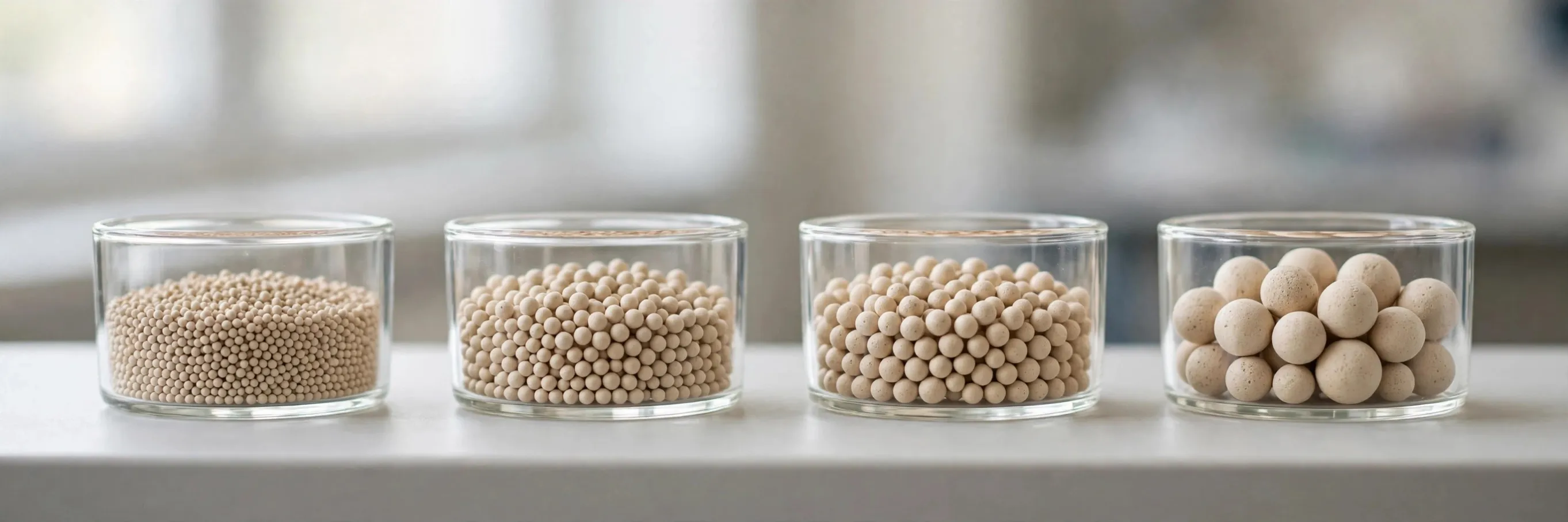
Molecular sieves are crystalline adsorbents with uniform pores of an exact size. A molecule smaller than the pore opening can enter and be adsorbed; a larger molecule is excluded. That single fact explains the grade names, the typical duties, and most selection mistakes.
Start with the pore size
The number in the grade name is the nominal pore opening in angstroms (Å). 3A has pores of about 3 Å, 4A about 4 Å, 5A about 5 Å, and 13X — a different crystal structure — about 10 Å. Water has a kinetic diameter of roughly 2.6 Å, so it enters every grade. Larger molecules are admitted or excluded depending on the grade, which is what makes selective drying and separation possible.
3A — drying without touching the product
3A adsorbs water but excludes most other molecules, including ethanol, solvents and many hydrocarbons. It is the standard choice when the liquid being dried must not be adsorbed itself: ethanol and solvent dehydration, refrigerant drying, and drying of cracked gas and other sensitive streams.
4A — the general-purpose dryer
4A admits water plus small molecules such as carbon dioxide and hydrogen sulfide. It is widely used for drying air and natural gas, and as a general industrial desiccant where some co-adsorption is acceptable.
5A — drying plus separation
5A adsorbs normal paraffins while excluding branched and cyclic hydrocarbons, so beyond drying it is used for separation duties: normal-paraffin extraction, hydrogen purification in PSA units, and oxygen/nitrogen separation processes.
13X — wide pores for pre-purification
With pores around 10 Å, 13X adsorbs water, carbon dioxide and a range of larger molecules and trace contaminants. Its main duty is pre-purification: removing water and CO2 from air before cryogenic separation, and deep purification of industrial gas streams.
How to choose
Work through four questions. First, what must be removed — only water, or also CO2 and other components? Second, what must NOT be adsorbed — the product itself, or valuable components? Third, is the duty only drying, or also separation? Fourth, what are the operating conditions — pressure, temperature, flow rate and regeneration method? The answers narrow the grade quickly: drying a product that must stay untouched points to 3A; mixed removal points to 4A; separation duties point to 5A; air pre-purification points to 13X.
If you send us those four answers together with your required quantity, we can confirm the grade and particle size for your unit. That is always a better starting point than ordering by grade name alone.